
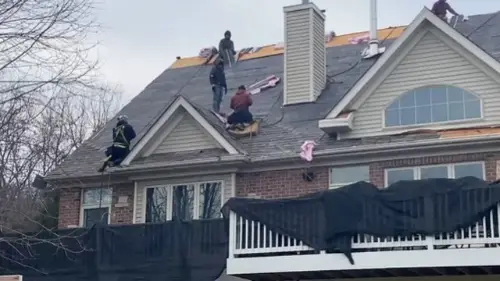
Within a day or two of a major hailstorm in northern Illinois, a familiar pattern starts. Trucks with out-of-state plates appear in neighborhoods. Yard signs pop up. Someone knocks on your door, says they were "working on a house down the street," and offers a free roof inspection. Some of these contractors do fine work. Many don't — and a few aren't contractors at all.
They're called storm chasers: companies that follow severe weather from region to region, sign as many jobs as possible while the damage is fresh, and move on when the work dries up. The problem isn't that they're from somewhere else. The problem is what happens after they leave — when a leak shows up next spring, a warranty needs honoring, or an insurance question comes up and the phone number no longer works.
This guide covers the red flags, how to vet any contractor in a few minutes, and what to do if you've already signed something. If you're dealing with storm damage right now, our storm damage repair team can give you a free, no-pressure inspection so you have an honest local opinion before you decide anything.
Why Storm Chasers Target Northern Illinois
Northern Illinois gets regular spring and summer hail, and the Rockford area sits right on the I-90 and I-39 corridors. That combination makes it easy for crews to drive in quickly after a storm, work a few neighborhoods hard, and leave.
After a widespread hail event, hundreds of homes may need roofs, siding, or gutters at the same time. Local contractors get busy, homeowners get anxious, and insurance money is on the table. That's the environment storm chasers are built for. Speed and pressure are their business model.
The Red Flags
No single item on this list proves a contractor is a storm chaser, but the more of these you see, the more careful you should be.
They found you, not the other way around
Unsolicited door-knocking right after a storm is the classic sign. So are flyers left on every door on the block and yard signs that appear overnight across a neighborhood. Established local contractors are usually busy fielding calls from homeowners who already know them.
No verifiable local address
Ask where their office is. A P.O. box, a hotel, a "temporary office," or an address that turns out to be a mailbox store is a warning. So is a truck, business card, or website that shows an out-of-state address with a local phone number added on.
Pressure to sign today
"We only have a few openings." "The price goes up tomorrow." "Your insurance company needs this signed right away." A legitimate contractor will give you a written estimate and time to think about it. Storm damage is urgent to stop from getting worse — a tarp handles that — but choosing who replaces your roof is not a same-day decision.
Asking you to sign something on the first visit
Be very cautious with any form presented as a simple "authorization," "inspection agreement," or "insurance paperwork" before you've seen a real estimate. Some of these documents are actually contracts that commit you to that contractor if your claim is approved, or that give them authority to deal with your insurance company on your behalf. Read every word, and don't sign anything you don't fully understand.
Offering to cover or waive your deductible
This one is simple: in Illinois, a contractor cannot promise to pay, rebate, or absorb any part of your insurance deductible to win your business. It's prohibited under the Illinois Home Repair and Remodeling Act. The deductible is your share of the loss under your policy. A contractor who offers to "take care of it" is either planning to inflate the claim or cut corners on the job — and either way, you're the one exposed.
Waiving or rebating an insurance deductible is illegal in Illinois. Any contractor who offers it is telling you up front that they're willing to break the rules on your job. Thank them and close the door.
Large upfront payment or cash only
Be wary of anyone who wants a large deposit before materials are delivered, asks you to sign over your insurance check before work starts, or prefers cash. Once the money is gone, you have very little leverage.
Claims of being "approved" by your insurance company
Insurance companies don't approve contractors for homeowners in the way storm chasers imply. In Illinois, you have the right to choose your own contractor. Be skeptical of anyone who suggests they have special standing with your carrier or that using them will guarantee approval.
Damage that appears during the inspection
Unfortunately, dishonest inspectors sometimes create "damage" while they're on the roof — scuffing shingles or denting soft metal to make a claim look stronger. That's fraud, and it can put your claim at risk. Take your own photos before anyone goes up, and ask for photos of everything they document.
A vague contract
A real contract spells out the scope of work, materials (including brand and product line), start and completion expectations, payment schedule, cleanup, permits, and warranty terms. "Replace roof per insurance scope" with a total at the bottom isn't enough.
How to Vet a Contractor in 15 Minutes
You don't need to become an expert to protect yourself. Before you sign with any contractor — including us — run through this checklist:
- Verify the roofing license. Illinois requires roofing contractors to be licensed under the Illinois Roofing Industry Licensing Act. You can look up any license on the Illinois Department of Financial and Professional Regulation (IDFPR) website. Make sure the name on the license matches the company on your contract.
- Get a certificate of insurance — from the insurance agent. Ask for proof of general liability and workers' compensation coverage, and have it sent directly from their insurance agent rather than handed to you as a photocopy. If a worker is hurt on your property and the contractor isn't covered, it can become your problem.
- Drive by the address. Look up the company's physical address and confirm it's a real business location in the area.
- Check how long they've been around. Look at reviews over a span of years, not just the past few weeks. A flood of recent reviews and nothing before the last storm is a pattern worth noticing.
- Ask for local references. Recent jobs in your town or nearby that you could drive past. A local contractor will have plenty.
- Ask who does the work. Will the company's own crew do the job, or will it be handed to subcontractors? Who do you call if there's a problem?
- Ask about permits. Most roof replacements in our area require a permit. A reputable contractor pulls it. Someone who suggests skipping it is cutting a corner that protects you.
- Get everything in writing. Scope, materials, price, payment schedule, timeline, and warranty — all in a signed contract before work begins.
Before you sign, ask yourself: "If this roof leaks in six months, who am I going to call — and will they answer?" If you can't answer that with confidence, keep looking.
What to Do When Someone Knocks on Your Door
You don't have to be rude, and you don't have to agree to anything. A simple approach works:
- Get their information. Ask for a business card with a physical address and license number. Take a photo of their truck.
- Don't let anyone on your roof on the spot. Tell them you'll schedule an inspection after you've done some research.
- Don't sign anything. Not an estimate, not an inspection form, not "insurance paperwork."
- Don't call your insurance company because they told you to. Get an independent inspection first so you know whether you actually have a claim. Our first 48 hours guide explains why that order matters.
- Check them out, then decide. Run through the vetting checklist above. A legitimate contractor will still be available tomorrow.
What If You Already Signed?
It happens — storm aftermath is stressful and the pitch can be convincing. If you've signed something and are having second thoughts:
- Read the entire document. Find out exactly what you agreed to, and look for any section describing your right to cancel and how to do it. Many home repair contracts include cancellation terms, and state and federal consumer protection laws may give you additional rights depending on how and where the contract was signed.
- Act quickly and in writing. Cancellation windows are often short. If you decide to cancel, do it in writing, keep a copy, and send it in a way you can prove was received.
- Don't hand over your insurance check until you're comfortable with the contractor and the work is progressing as agreed.
- Get help if something seems wrong. If you believe a contractor has misled you or committed fraud, you can contact the Illinois Attorney General's consumer protection division. For insurance-related concerns, the Illinois Department of Insurance handles consumer complaints. If you're unsure of your rights under a contract, talk to an attorney.
This isn't legal advice — every situation and contract is different — but the key is not to ignore the problem and hope it goes away.
Why "Local" Actually Matters
It's easy to read "choose a local contractor" as a sales line. Here's why it has real consequences:
Warranties only matter if someone honors them. A manufacturer warranty covers defective materials. Workmanship — how the roof was installed — is the contractor's responsibility. If the installer is gone, a workmanship warranty is just a piece of paper.
Problems show up later. Installation mistakes like improper flashing, missing ice and water shield, or poor nailing don't leak on day one. They show up during the first hard winter or the next heavy rain.
Insurance claims take time. Supplements, depreciation holdback, and final paperwork can extend well past the day the roof is finished. You need a contractor who's still around to complete that process.
Local contractors know local conditions. Freeze-thaw cycles, ice dams, snow load, local permit requirements, and the older housing stock across the Rockford area all affect how a job should be done. Our guide to preventing ice dams is a good example of the details that matter here.
How We Help
Littlefield Siding is a family business that has operated from 321 E Riverside Blvd in Loves Park since 1986. We're not a franchise, and we don't follow storms from state to state. When the out-of-town trucks leave, we're still here.
After a storm, we offer free inspections of your roof, siding, windows, gutters, soffit, and fascia, with a written report and photos. We'll tell you honestly whether you have storm damage and whether a claim makes sense. We don't ask you to sign anything at the inspection, we never offer to cover deductibles, and we never inflate damage.
If you move forward, we pull the required permits, meet your adjuster on-site, handle supplements when the estimate comes up short, and complete the work with our own crew. And six months later, when you have a question, you'll reach the same people.
Even if you're working with another contractor, we're happy to give you a second opinion. A ten-minute conversation can help you slow down and make a better decision.
Talk to a Local Contractor First
If someone has knocked on your door after a storm, or you're trying to figure out who to trust, request a free inspection or call us at (815) 636-6446. No pressure, no paperwork at the door.
We serve homeowners in Loves Park, Rockford, Machesney Park, Belvidere, Roscoe, Rockton, and communities across northern Illinois.